
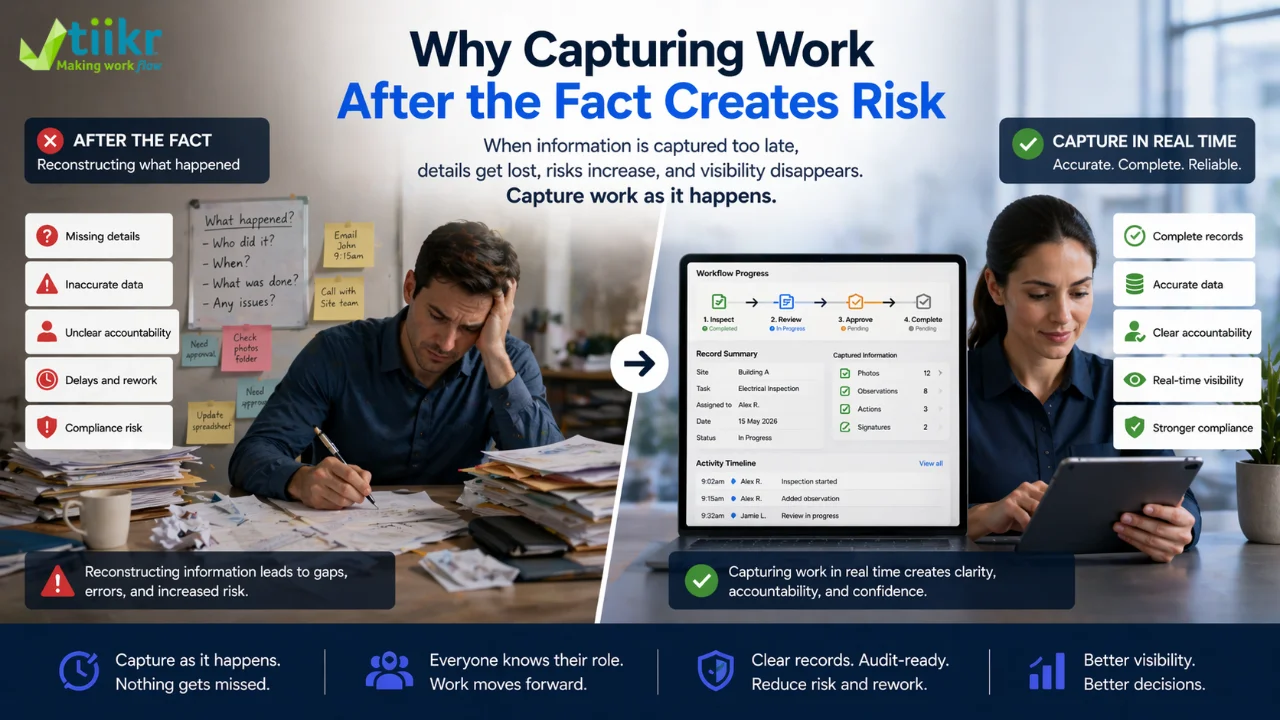
Capturing work after the fact means documenting what happened only after the work is completed. This creates risk because key details, decisions, and context are often lost by the time they are recorded.
Why Do Businesses Rely on After-the-Fact Capture?
In many operations, the priority is getting the job done.
Documentation is treated as a separate task:
- completed later
- delegated to someone else
- or reconstructed from memory
This approach feels efficient in the moment.
But it creates problems downstream.
Why Capturing Work After the Fact Creates Risk
When information is recorded after the work:
- details are forgotten or simplified
- decisions are not clearly documented
- timing of actions becomes unclear
- issues are omitted or softened
- context is missing
The result is a record that shows what was completed, but not how or why.
This is the core issue with capturing work after the fact rather than during the work itself.
And, this is a common pattern where records are assembled after completion rather than captured during the work itself.
How This Impacts Operational Visibility
Delayed capture directly affects operational visibility.
When information arrives late:
- problems cannot be identified early
- teams cannot act in real time
- decisions are made without full context
This is where operational visibility breaks down, not because data is missing, but because it is too late to be useful.
The Link to Work Outside Systems
This issue is closely tied to how work actually happens.
As explored in The Work That Actually Runs Your Business Isn’t in Your System, much of the real work happens:
- in conversations
- through quick decisions
- outside formal systems
When that work is not captured at the time, it must be reconstructed later.
That reconstruction is where risk is introduced.
Where Risk Starts to Appear
After-the-fact capture creates several types of risk:
1. Inaccurate Records
Information is based on memory rather than real events.
2. Delayed Issue Detection
Problems are only visible after they have escalated.
3. Weak Accountability
It becomes unclear who made decisions or when actions occurred.
4. Compliance Exposure
Incomplete records increase audit and regulatory risk.
5. Rework and Inefficiency
Teams revisit issues that could have been avoided.
These are not edge cases.
They are common across operations that rely on delayed documentation.
Why Reconstruction Doesn’t Work
Reconstructing work assumes that:
- people remember accurately
- all steps were visible
- nothing important was missed
In reality, this rarely holds true.
The longer the delay between work and capture, the greater the gap between reality and the record.
What Good Looks Like
Reducing risk starts with changing when capture happens.
Instead of documenting after the work:
- capture information during the work
- link actions to specific steps
- record decisions as they occur
- ensure context is preserved
This creates a record that reflects reality, not a summary of it.
The Role of Structured Workflows
Structured workflows help solve this by embedding capture into the process.
They:
- guide users through each step
- prompt required information at the right time
- record actions, approvals, and changes
- connect everything into a single flow
As work progresses, the record builds naturally. This is the same principle behind digital workflows, where each step contributes to a complete and accurate record of work.
Where This Fits in Practice
In environments such as:
- inspections
- compliance processes
- service workflows
- project handovers
timing is critical.
If capture is delayed, visibility and accuracy are compromised.
Capturing work at the point it happens ensures:
- better visibility
- clearer accountability
- stronger outcomes
Final Thought
Capturing work after the fact may seem efficient.
But it shifts risk into every part of the operation.
The alternative is simple.
Capture the work as it happens, so the record reflects reality, not reconstruction.