
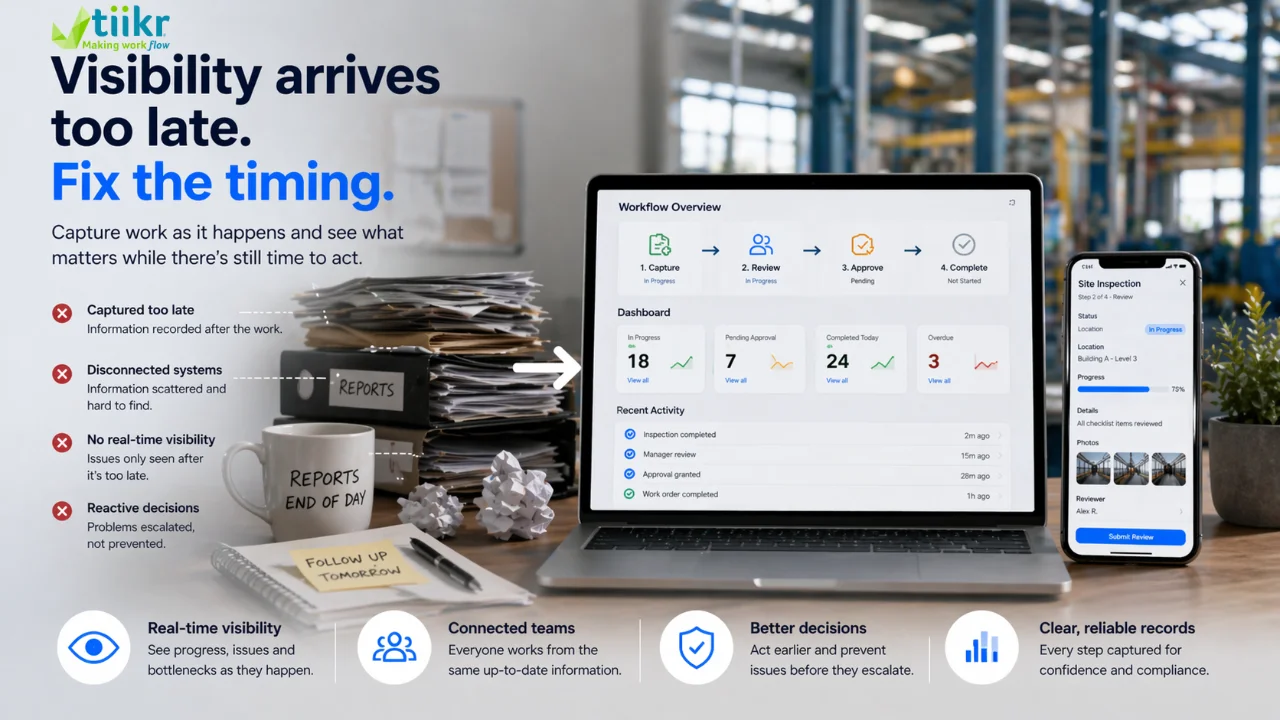
Most businesses do not have a data problem.
They have a timing problem.
Information is usually captured, but it becomes visible too late to influence decisions. This leads to reactive management, delayed issue detection, and unnecessary rework.
Why Does Visibility Arrive Too Late?
In many operations, visibility depends on when information is recorded and reviewed, not when work actually happens.
Common patterns include:
- data captured after the job is complete
- updates entered at the end of the day
- reports reviewed after issues have escalated
- dashboards checked only when something goes wrong
By the time the information is visible, the outcome is already fixed.
What Happens When Timing Is Off?
When visibility is delayed, businesses experience:
- issues identified after they impact customers
- rework that could have been avoided
- incomplete or inconsistent records
- reliance on follow-ups and manual communication
- reduced confidence in reporting
These problems are not caused by people.
They are caused by how and when information is captured. This aligns with a broader pattern seen in operations where records are often assembled after the fact, rather than created during the work itself.
Why Dashboards Do Not Solve the Problem
Dashboards improve access to information, but they do not change when that information becomes available.
They rely on:
- someone checking them
- data being complete and up to date
- time being available to interpret them
In practice, most teams are focused on completing work, not reviewing reports.
This creates a gap between:
- what is happening in the operation
- what is visible in the system
Where Visibility Actually Breaks Down
Visibility issues usually occur in three places:
1. Capture happens too late
Information is recorded after the work, not during it.
2. Systems are disconnected
Data sits across forms, emails, spreadsheets, and reports, making it difficult to see a complete picture .
3. Work is not structured
Without defined steps and ownership, information depends on individual habits rather than process design .
What Does Good Visibility Look Like?
Operational visibility improves when information becomes available at the moment it can still influence the outcome.
This means:
- capturing data during the work
- linking information to specific steps and responsibilities
- making updates visible as the process progresses
- reducing reliance on end-of-day reporting
Instead of looking back, teams can act in real time.
How to Improve Visibility Timing
Improving visibility is not about collecting more data.
It is about changing when and how it is captured.
Key approaches include:
- capturing work at the point it is performed
- structuring processes into clear, connected steps
- assigning responsibility at each stage
- ensuring data flows with the workflow, not after it
This shifts visibility from retrospective to real-time.
Where This Fits in Practice
This is the approach behind structured digital workflows.
Rather than treating forms, reports, and approvals as separate tasks, workflows connect them into a single process where:
- each step captures required information
- progress is visible across teams
- the final record reflects how the work actually occurred
Platforms like Tiikr are designed around this principle, embedding data capture directly into the workflow so visibility is created as part of normal operations
Final Thought
Most operational issues are not caused by missing information.
They are caused by information arriving too late.
When visibility aligns with the timing of work, many downstream problems begin to resolve before they occur.
FAQs
What is operational visibility?
Operational visibility is the ability to see the status, progress, and outcomes of work across a process. It depends on how clearly and how quickly information is captured and shared.
Why is timing important for visibility?
If information becomes visible after decisions are made, it cannot influence outcomes. Timely visibility allows teams to act before issues escalate.
How do digital workflows improve visibility?
Digital workflows structure how work is performed, ensuring information is captured at each step and made visible as the process progresses.
Is more data the solution to poor visibility?
No. Most organisations already have enough data. The issue is when that data becomes available, not how much exists.