Most businesses rely on systems to manage operations.
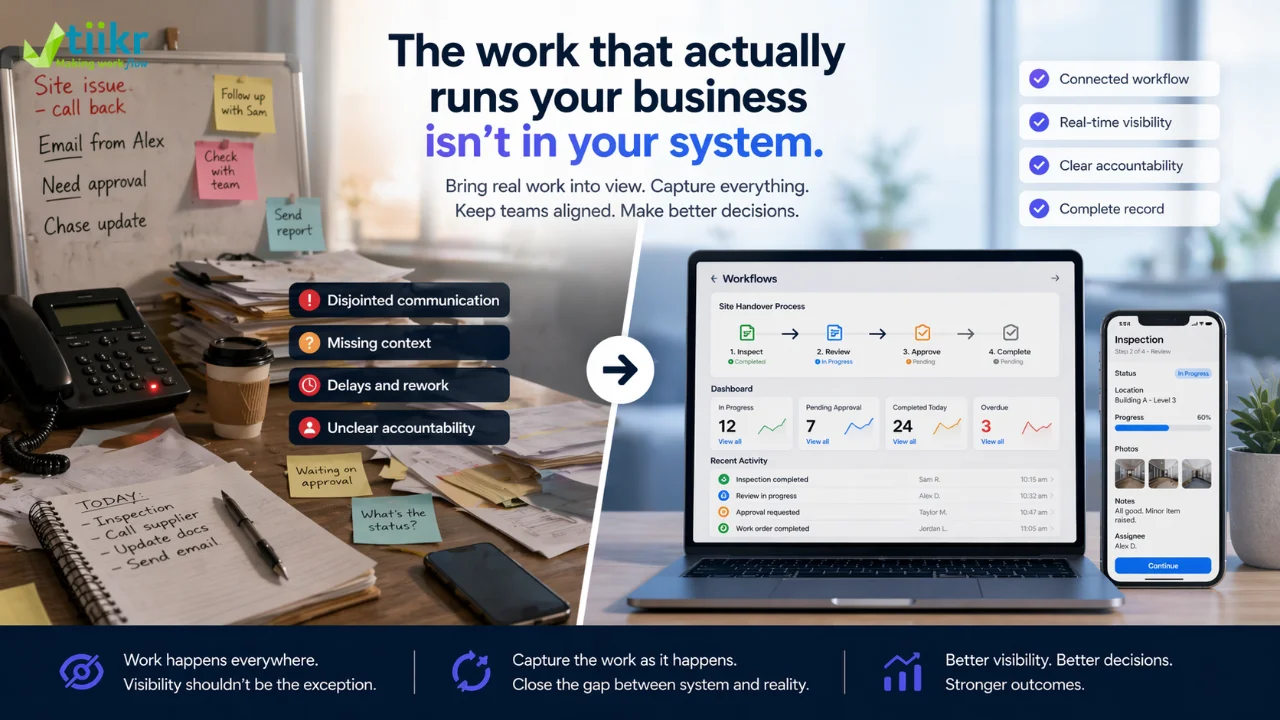
But a large part of the work that actually gets things done happens outside those systems.
This includes conversations, decisions, workarounds, and judgement calls that are never formally captured.
Where Does This “Off-System” Work Happen?
In day-to-day operations, work often happens in places like:
- phone calls between team members
- verbal instructions on-site
- quick decisions made under pressure
- handwritten notes or temporary fixes
- messages across email, SMS, or chat
The system may record the outcome.
But it rarely captures how that outcome was reached.
Why This Creates Problems
When work happens outside the system, several issues begin to appear:
- decisions are not clearly documented
- responsibility becomes harder to track
- information is inconsistent or incomplete
- teams rely on memory instead of records
- handovers become unclear
Over time, this creates gaps between what actually happened and what is recorded.
The System vs Reality Gap
Most systems are designed around how work should happen.
But real operations are rarely that clean.
In practice:
- steps are skipped or combined
- decisions are made earlier than expected
- issues are resolved before being formally logged
- teams adapt based on experience
This creates a gap between:
- the designed process
- and the real process
That gap is where operational visibility is lost
Why Capturing Work After the Fact Doesn’t Work
Many businesses try to close this gap by documenting work later.
This usually results in:
- missing details
- simplified or inaccurate records
- delays in reporting
- inconsistent data
By the time the information is entered, the context is gone.
This is the same pattern seen in operations where records are assembled after completion rather than created during the work itself.
What Happens During Handovers
This issue becomes most visible during handovers between teams.
When work is not fully captured:
- the next team relies on assumptions
- key decisions are unclear
- issues are rediscovered instead of resolved
- accountability becomes blurred
The more stages a process has, the more this compounds.
What Good Looks Like
To reduce off-system work, the goal is not to eliminate human judgement.
It is to make sure that important actions and decisions are captured as part of the process.
This means:
- capturing work as it happens
- linking decisions to specific steps
- recording responsibility at each stage
- ensuring information moves with the workflow
Instead of reconstructing the work, the system reflects it.
The Role of Structured Workflows
Structured workflows help bring work back into the system by:
- guiding users through each step
- prompting required inputs at the right time
- capturing actions, approvals, and changes
- connecting each stage into a single process
This reduces reliance on memory, emails, and follow-ups.
It also ensures that the final record reflects what actually occurred.
Where This Fits in Practice
In environments like inspections, compliance, service, and handovers:
- work often happens in the field
- decisions are made quickly
- coordination between teams is critical
If capture is delayed, visibility is lost.
This is why capturing work at the point it happens becomes essential, especially when combined with structured workflows that keep everything connected.
Final Thought
Your system may show what was completed.
But it often misses how the work was actually done.
Closing that gap is not about adding more reporting.
It is about capturing the work itself, as it happens, so the system reflects reality, not just the outcome.