
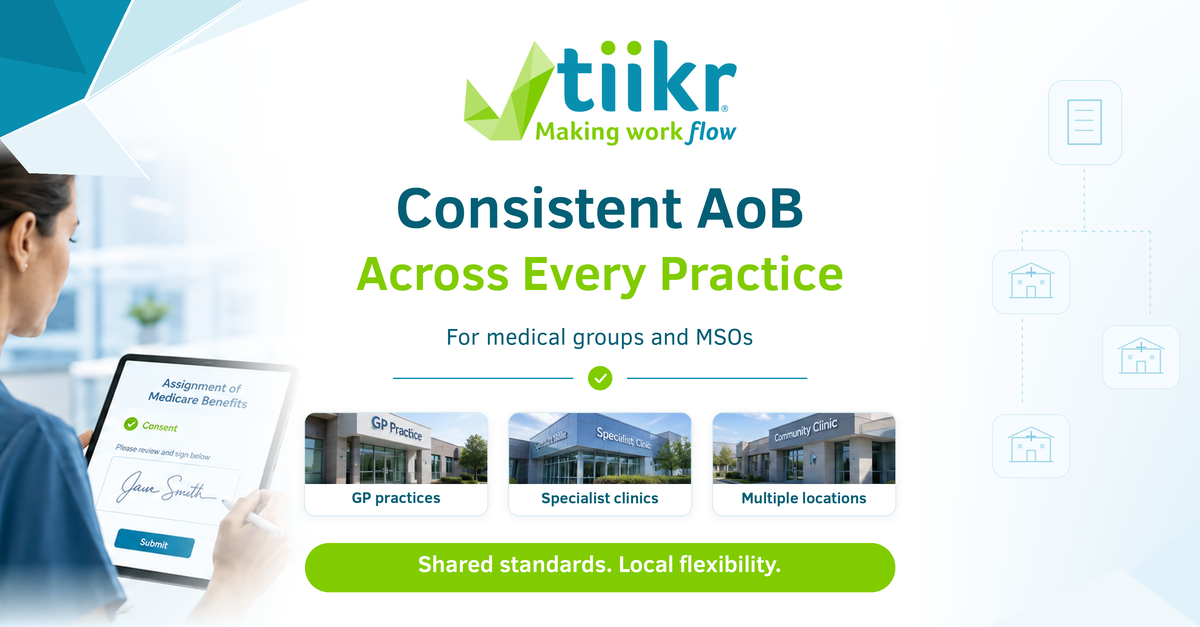
When a medical group supports several practices, small differences in administration can create substantial extra work.
One practice might collect Medicare Assignment of Benefit agreements before appointments. Another completes them after the consultation. A third relies on a particular staff member to follow up outstanding agreements and file the records.
Each team may have developed a process that works locally. The difficulty comes when staff move between locations, central billing teams need information, or the group introduces an updated procedure.
For medical groups and Medical Support Organisations (MSOs), a consistent AoB approach can make these handovers easier. It gives practice teams a common foundation while allowing for differences in patients, services and local operations.
What does a consistent AoB process look like?
A consistent Medicare AoB process uses shared standards for agreement content, staff responsibilities, completion checks and record handling. Practices can adapt how they deliver that process to suit their setting.
For example, a GP practice and a specialist clinic may collect agreements at different points in the patient journey. Both can still follow the same expectations for checking completion, identifying outstanding work and making records available to authorised staff.
The aim is to make the process dependable wherever a patient is seen.
Start with the current Medicare requirements
Assignment of Benefit records a patient’s agreement for their Medicare benefit to be paid to the practitioner as full payment for a bulk-billed service.
Current arrangements allow agreements to be completed before or after the service, electronically or on paper. Practices may use their own forms, provided the required information is included. Services Australia’s AoB guidance explains the available options.
The Department’s bulk billing FAQs confirm that a valid agreement must be obtained before the Medicare claim is submitted.
A 12-month transition period began on 1 July 2026, including temporary verbal assignment arrangements. The Department encourages providers preparing digital solutions to continue that work. For medical groups, this provides time to review existing processes, test improvements and train teams. Read the Department’s transition update.
This guide focuses on AoB for Medicare bulk-billed services.
Agree what should be shared and what can vary
A useful starting point is a short operating standard that describes the expectations every participating practice will follow. It should also identify where practices can adapt the process to suit their patients, services and local operations.
Agreement templates
The group can maintain approved agreement content, version control and a clear process for updates. Individual practices can apply relevant branding and practitioner details where appropriate.
Patient completion
Every practice should follow agreed requirements for issuing agreements, confirming completion and helping patients who need assistance. The timing and collection method can reflect the practice’s services and patient journey.
Staff responsibilities
The group should define who is responsible for each stage and how unresolved items are escalated. Individual practices can assign those responsibilities to the staff members or teams that best fit their operations.
Outstanding agreements
Shared status definitions and follow-up expectations help teams understand what has happened and what needs attention. Each practice can determine how those tasks are allocated locally.
Record handling
The group should establish how completed agreements are stored, accessed and retrieved. Access can then be configured according to each person’s role and authorised responsibilities.
Training and onboarding
Common guidance gives staff a consistent understanding of the AoB process. Each practice can supplement it with examples and instructions relevant to its own services and workflows.
This approach gives central teams a process they can support and local teams clear instructions they can use.
It also makes change easier. When official guidance or an internal procedure changes, the group can coordinate the update instead of asking every practice to interpret and redesign its approach independently.
Give every step a clear owner
A shared template is only useful when people know what happens next.
For each practice, identify who:
- starts the agreement and checks the relevant details
- helps the patient complete it
- confirms completion and identifies missing information
- follows up outstanding agreements
- makes the completed record available for the billing process
- handles record requests and escalates unusual situations.
The roles may sit with reception, a practice manager, a billing team or an authorised shared service. What matters operationally is that responsibility remains clear as work moves between them.
For instance, if a patient leaves with an agreement outstanding, reception and a central administration team should be able to establish who will follow up. Otherwise, both teams may contact the patient—or each may assume the other has done so.
Group support also needs to preserve practitioner accountability. The Department’s guidance states that the practitioner claiming the benefit remains responsible for ensuring AoB records are retained and can be produced, even when another organisation or software provider stores them. See the Department’s record-keeping guidance.
Allow for differences between practices
Consider a group supporting two GP practices and a specialist clinic.
One GP practice may find pre-service agreement collection convenient. The specialist clinic may prefer to complete the agreement after the consultation, when the service details are known. Another location may need more staff-assisted completion for patients who find digital forms difficult.
A common operating standard can accommodate all three.
The practices can use different collection pathways while sharing completion checks, staff instructions and record-handling expectations. Local feedback should help refine these pathways, particularly where a process creates extra steps for patients or reception staff.
Enduring agreements also need appropriate handling. For MyMedicare patients, agreements relate to a particular practitioner at the patient’s registered practice. A group should not assume an agreement applies to every GP or location in its network. Read Services Australia’s enduring assignment guidance.
Make records accessible to the people who need them
A consistent approach should make it straightforward for authorised staff to locate the right agreement.
Services Australia requires AoB agreements to be retained for two years from the date the claim is made. Patients must also be given a copy if they request one. Review the record-keeping requirements.
For an MSO, the practical questions extend beyond storage:
- Can the relevant practice retrieve the agreement without relying on one person?
- Can an authorised billing team identify the record associated with its work?
- What access does a regional manager need to support a practice?
- What happens to access and retrieval arrangements when staff or practitioners leave?
Central oversight can often use operational information, such as outstanding work and its age. Detailed patient records should be available according to the person’s role and authorised responsibilities.
Work with the systems already in place
Before introducing another tool, review how each practice currently manages AoB.
Identify where patient and practitioner details originate, how agreements are collected, where completed records are stored and how billing staff establish that the necessary agreement is in place.
This review helps distinguish a training issue from a process gap or a missing software capability.
Where a new workflow is proposed, test the full journey. Check whether staff must re-enter information, how records return to the appropriate system and whether any handover requires manual action.
For groups using different practice systems, documenting these differences early makes implementation planning more realistic.
Build consistency into onboarding
A new practice should have a clear route into the group’s AoB process.
That onboarding should cover the applicable templates, practitioner details, local responsibilities, access arrangements and patient completion options. It should also explain where to get help.
Use realistic scenarios in staff training: an unfinished agreement, a changed practitioner, a patient needing assistance, or a request for a completed record.
Keep the guidance accessible and assign someone to maintain it. A short, current procedure is more useful than a detailed document that staff cannot find or no longer trust.
Test the approach before extending it
Start with a small selection of practices that reflects the group’s operating differences.
Establish how the existing process performs, then assess the proposed workflow using the same measures. Useful measures include staff handling time, follow-up effort, incomplete agreements, retrieval time and patient feedback.
Include the effort required for setup, training and ongoing support. A process that works well in one location may need adjustment before it is suitable elsewhere.
For an MSO, the value of the pilot is a tested operating approach that can be repeated with confidence.
Plan a consistent AoB workflow with Tiikr
A coordinated AoB deployment starts with understanding how your practices work and where teams need better support.
Explore Tiikr’s Medicare Assignment of Benefits solution to start a discussion about your group’s agreement collection, administration and record-handling needs.
Bring the local practice perspective together with operations, billing and IT. That creates a practical foundation for a workflow your group can maintain, and your teams can use every day.