
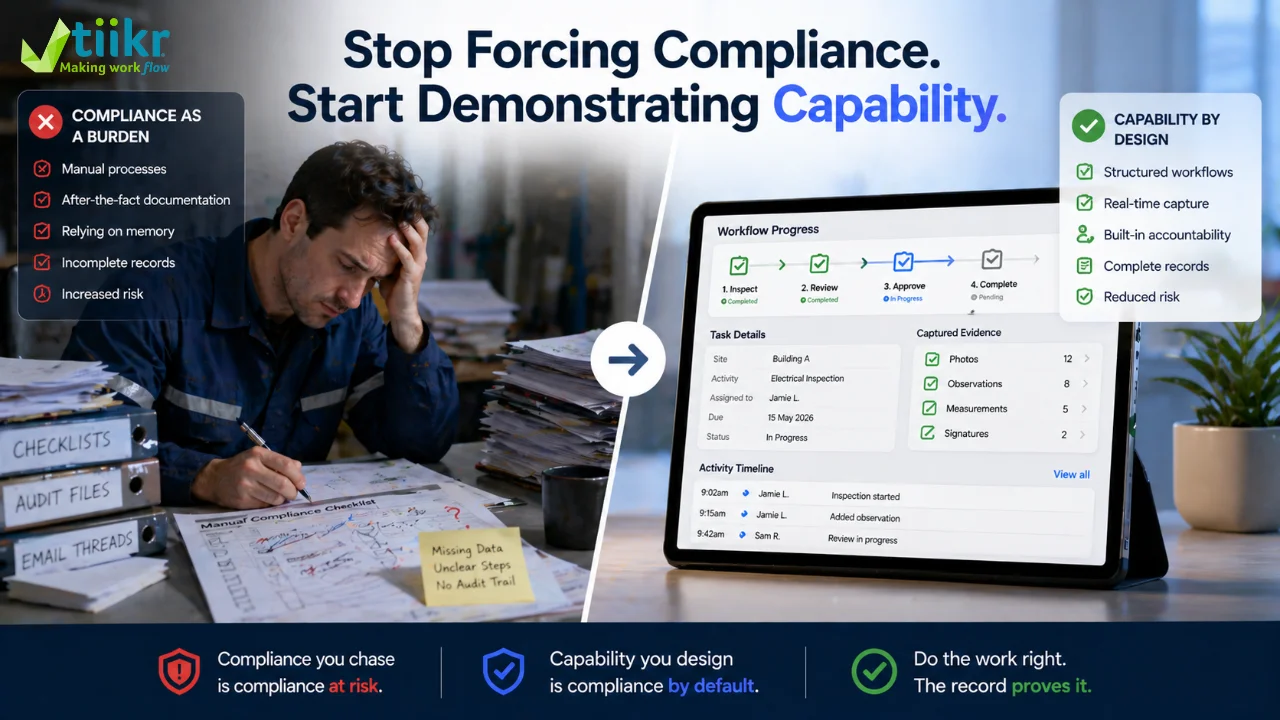
What Is Compliance vs Capability?
Compliance vs capability is the core issue behind why many compliance frameworks fail in practice. Compliance often relies on people remembering rules, while capability is built into how work is actually done and recorded.
Why Compliance Becomes a Burden
In many businesses, compliance is treated as a separate layer of work.
It shows up as:
- additional forms
- manual checks
- end-of-process documentation
- audits after the fact
This approach creates friction.
Teams focus on completing the work first, then try to “make it compliant” later.
Where Compliance Frameworks Break Down
On paper, compliance frameworks look structured and complete.
In practice, they break down because:
- work happens under time pressure
- teams make decisions in real time
- processes are adapted to fit the situation
- information is captured after the work
This leads to a gap between:
- what compliance expects
- and what actually happens
That gap introduces risk.
The Real Issue: Reliance on Memory and Discipline
Most compliance systems rely on people to:
- remember required steps
- capture the right information
- follow the correct sequence
- document decisions accurately
Even experienced teams cannot do this consistently under pressure.
This is why compliance often becomes:
- reactive
- inconsistent
- difficult to audit
Compliance vs Capability
A more effective approach is to shift the focus from compliance to capability.
Compliance-driven approach:
- “Did we follow the rules?”
- checked after the work
- dependent on documentation
Capability-driven approach:
- “Was the work done correctly?”
- embedded in the process
- demonstrated through the record
Instead of proving compliance after the fact, the system demonstrates it as work is completed.
Why Demonstrating Capability Works Better
When systems are designed around capability:
- required steps are built into the workflow
- data is captured during the work
- decisions are recorded as they happen
- responsibility is clearly assigned
The Role of Real-Time Capture
This removes the need to “remember compliance”.
It becomes part of how work is done.
A key part of this shift is capturing work as it happens.
As explored in earlier discussions on operational visibility, timing matters.
If information is captured late:
- compliance becomes reconstruction
- details are lost
- risk increases
If captured during the work:
- records are accurate
- context is preserved
- compliance becomes visible
From Documentation to Evidence
Traditional compliance focuses on documentation.
But documentation alone is not enough.
What matters is evidence.
Evidence shows:
- what was done
- when it was done
- who did it
- how decisions were made
This is the difference between:
- saying work was compliant
- and being able to demonstrate it
Designing Systems Where Compliance Is a Byproduct
To move from compliance to capability, systems need to:
- guide work through structured steps
- capture required information at each stage
- enforce sequence where needed
- link actions to people and time
- produce a complete record automatically
This is where structured digital workflows become important.
They ensure that:
- compliance is not an extra task
- it is embedded in the process
Where This Fits in Practice
In areas such as:
- inspections
- quality assurance
- safety processes
- service and maintenance
- project handovers
compliance is critical.
But relying on manual processes creates gaps.
Designing for capability ensures:
- consistency
- visibility
- audit readiness
Final Thought
Compliance should not depend on people remembering what to do.
It should be built into how work is performed.
When systems are designed around capability, compliance becomes a natural outcome, not an added burden.
FAQ
What is compliance vs capability?
Compliance checks if rules were followed, usually after the work. Capability ensures the work is done correctly by embedding requirements into the process itself.
Why do compliance processes fail in practice?
They rely on memory, manual steps, and after-the-fact documentation, which leads to inconsistency and missing information.
How can compliance become a natural outcome of work?
By building it into the workflow so steps, data capture, and decisions happen as part of the work, not after it.
What is the risk of capturing work after the fact?
It leads to lost details, unclear decisions, and inaccurate records, increasing operational and compliance risk.
How do digital workflows improve compliance?
They guide work through defined steps and capture information in real time, creating consistent and complete records.
Why is demonstrating capability better than proving compliance?
It shows how work was actually performed, with clear evidence of actions, timing, and responsibility.