
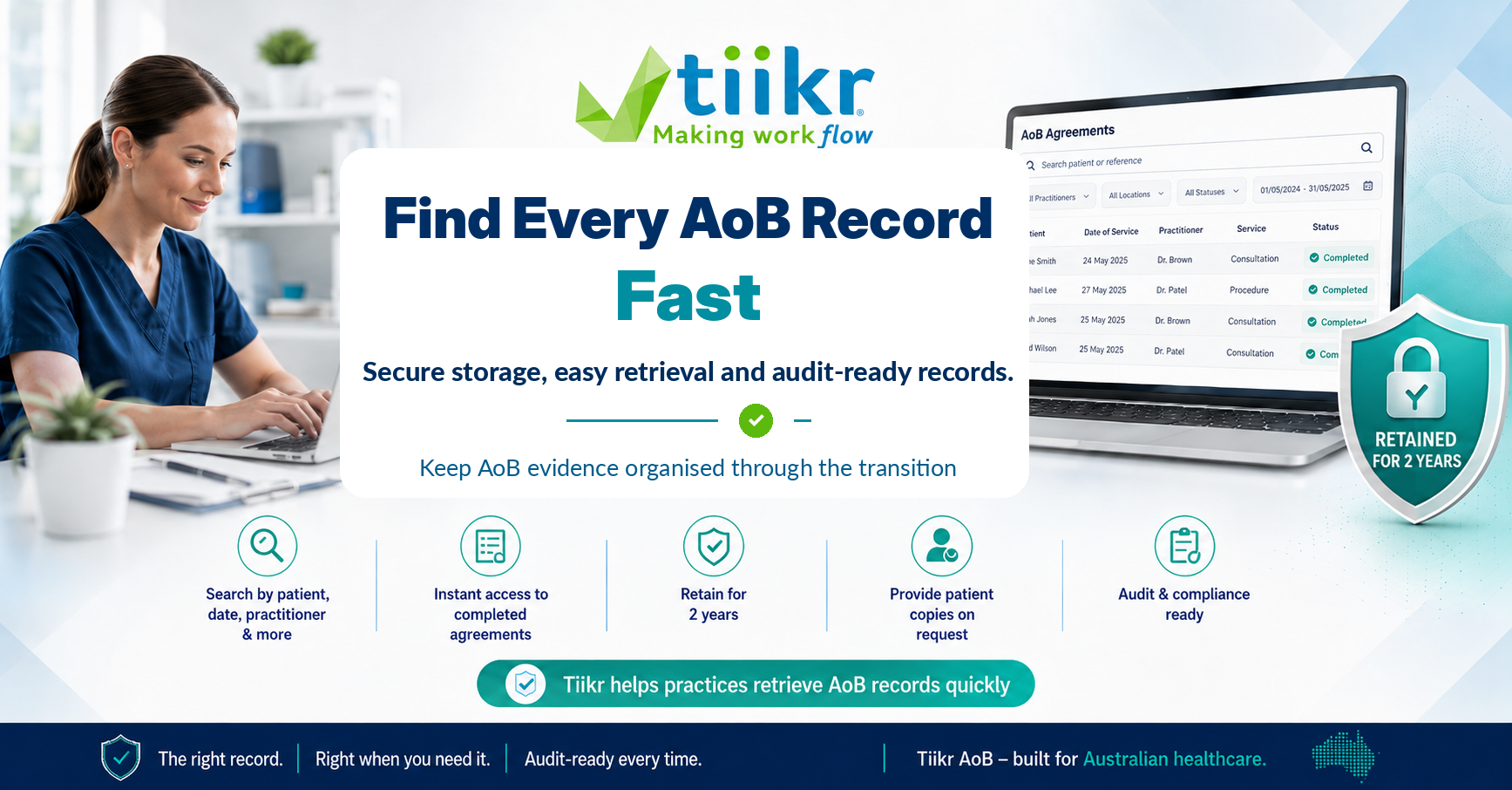
Capturing AoB is only half the job
A Medicare Assignment of Benefit agreement is only useful if the practice can find it later.
For GP clinics and specialist practices, this is where many paper-based or semi-digital processes start to create problems.
The agreement may have been signed, but staff still need to know exactly where it is stored and how to retrieve it.
It may be sitting in a patient record, scanned folder, staff inbox, download folder, shared drive, paper file or billing system attachment.
And can it be found quickly when needed?
That is why AoB readiness should include record retrieval from the beginning.
What the official guidance says about retention
Services Australia states that health professionals need to retain a copy of the Assignment of Benefit agreement for two years from the date the claim is made.
Services Australia also explains that patients are no longer required to keep a copy of the agreement, but providers must give the patient a copy if requested.
That makes retrieval a real operational requirement.
It is not enough to know that the agreement was signed; the practice also needs to be able to locate the completed record quickly when required.
Why retrieval matters for GP practices
GP practices can generate high volumes of AoB activity.
As a result, if each agreement is handled manually, even a small amount of follow-up can become a large administrative task.
Practice staff may need to confirm details such as:
- whether the agreement was completed
- who signed it
- whether it was pre-service or post-service
- the relevant date
- which practitioner or provider was involved
- whether a copy was provided to the patient
- whether the record can be retrieved quickly if needed
A digital retrieval process can help reduce the time staff spend searching across paper files, scanned documents and inconsistent storage locations.
Why retrieval matters for specialist practices
Specialist practices may deal with more complex service and billing contexts.
A patient may attend for a consultation, procedure, follow-up, telehealth appointment or other specialist service.
In addition, the final service may not match the original booking, the rendering practitioner may differ from the one expected, and the patient or assignor may complete the agreement after the appointment.
In that environment, it is important that the completed AoB agreement can be found against the right patient, date, practitioner, service and status.
A record that is technically stored but practically hard to locate can still create a problem for the practice.
Searchability should be designed into the workflow
Record retrieval is much easier when the workflow captures useful metadata from the start.
A good AoB workflow should help practices search or filter by practical fields such as:
- patient name
- date of service
- date of agreement
- provider or practitioner
- assignment type
- completion status
- service context
- location or practice site
- signed, unsigned, declined, voided or replaced status
For that reason, retrieval is not simply a storage issue; it is also a workflow design issue.
When an agreement is created, completed and stored through a structured process, staff are far more likely to find it quickly when they need it.
Audit-ready does not mean complicated
The phrase “audit-ready” can sound heavy.
In practice, it means something simpler.
In practical terms, an audit-ready process means authorised staff can produce the agreement when required, provide a patient copy on request, confirm completion and understand whether a record was replaced or voided. A good workflow should make this easier, not harder.
Patient copy requests
Patient copy requests should not create a scramble.
Services Australia says providers must give the patient a copy of the Assignment of Benefit agreement if requested.
A structured digital workflow can make this much simpler. Instead of searching through paper files, scanned folders or inboxes, authorised staff can locate the completed agreement and provide the copy through the practice’s approved process.
This saves staff time while also supporting a better patient experience.
How Tiikr helps practices find AoB records
The Tiikr Medicare Assignment of Benefits solution helps practices manage AoB as a structured workflow with completed records that can be retained and retrieved.
The goal is to reduce fragmented record handling so that a completed AoB agreement does not disappear into a paper tray, inbox or local folder. Instead, it becomes part of a managed workflow record.
This is particularly important for practice managers, billing teams and administrative staff who may need to retrieve that record later.
The value lies not only in capturing the agreement, but also in being able to find it when needed.
Frequently Asked Questions:
How long must Medicare AoB agreements be retained?
Services Australia states that health professionals need to retain a copy of the Assignment of Benefit agreement for two years from the date the claim is made.
Do patients need to keep a copy of the AoB agreement?
Services Australia states that patients are no longer required to keep a copy of the Assignment of Benefit agreement, but providers must give the patient a copy if requested.
What should practices search by?
A practical AoB retrieval process should allow authorised staff to search or filter by patient, date, practitioner, provider, agreement type and completion status.
A practical next step
A simple way to test your current retrieval process is to choose one completed AoB agreement and ask:
- How quickly can staff find it?
- Can they confirm who signed it and when it was completed?
- Can they provide a copy if requested?
- Can they identify whether it was pre-service, post-service, replaced, voided or incomplete?
Can they identify whether it was pre-service, post-service, replaced, voided or incomplete?
If the answer is unclear, your practice may need a more structured AoB workflow.
Book an AoB readiness review with Tiikr and see how a structured AoB workflow could fit your practice.