
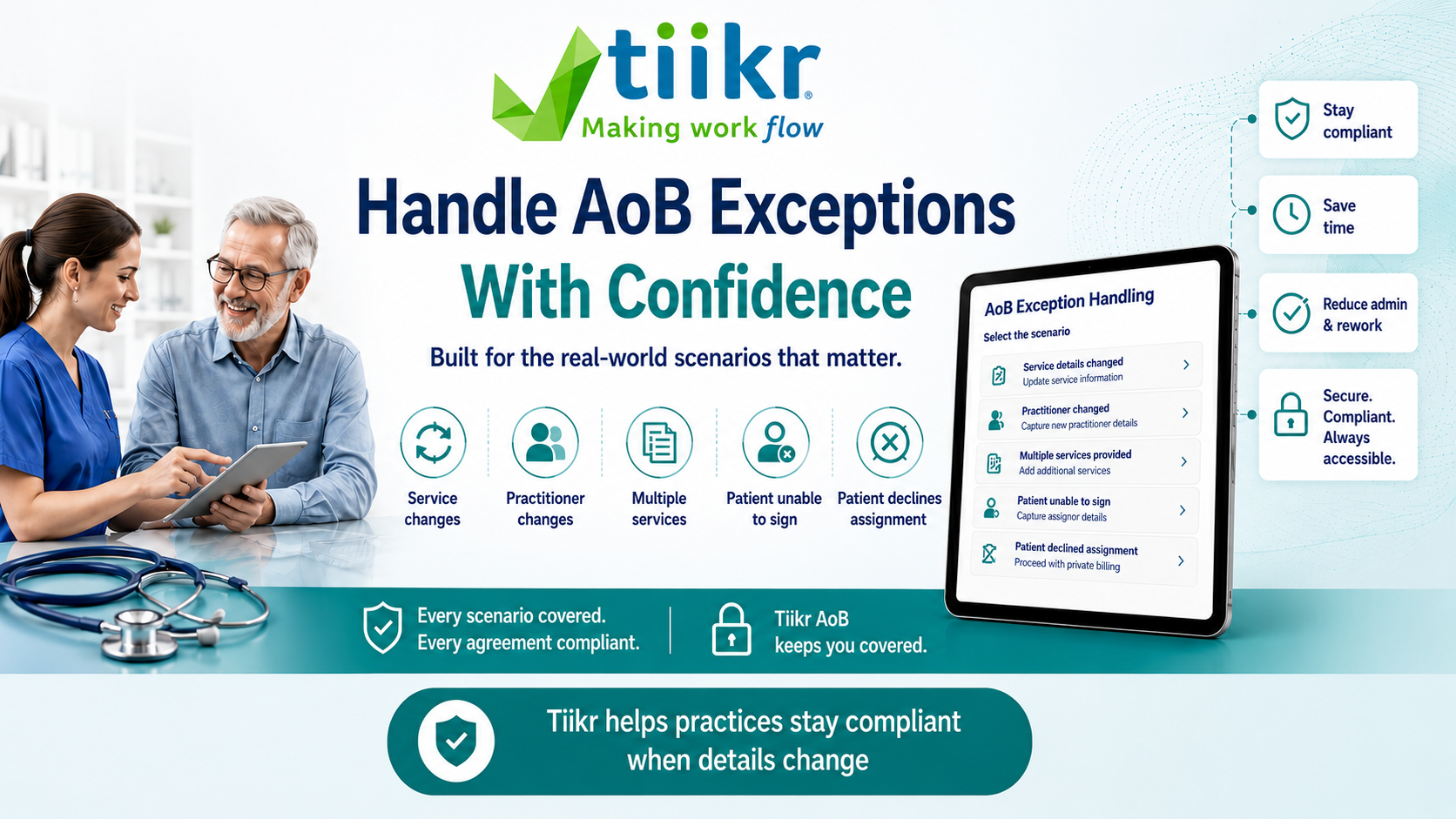
The real test of an AoB process is the exception
Medicare AoB exceptions are situations where the standard Assignment of Benefit process no longer matches what happened in the patient journey.
The simple AoB scenario is rarely the one that causes the most concern. The real test is what happens when something changes.
What happens if the service changes? What if a different practitioner renders the service? What if the patient cannot complete the agreement, an assignor is required, or the patient does not agree to assign their Medicare benefit?
What if the agreement was started before the service, but the final billing details are only known afterwards?
These are not remote edge cases. They are part of real practice administration, which is why GP clinics and specialist practices should include exception handling in their AoB readiness plans.
Why Medicare AoB exceptions matter in busy practices
In a busy medical practice, staff need clear pathways when circumstances change. They should not have to interpret the process from scratch every time an exception occurs.
A basic form can capture information when everything goes as expected. However, a structured workflow becomes much more important when the patient journey, service or billing context changes.
For practices, the objective is not to anticipate every possible unusual scenario. It is to make common exceptions visible and give staff a clear path to the next step.
Common Medicare AoB exception scenarios
A practical AoB workflow should consider at least the following situations.
The service changes
The service the practitioner ultimately provides may differ from what the practice expected when staff started the pre-service agreement.
In that case, the practice may need to collect a new or updated agreement that reflects the actual service.
The practitioner changes
If the rendering practitioner changes, the original agreement may no longer match the service context.
The practice may need an updated pre-service agreement or a post-service agreement.
The final MBS item is only known later
For some services, particularly in specialist practice, the practice may only confirm the final MBS item after the consultation or procedure.
That may make post-service AoB more suitable.
The patient is unable to complete the agreement
A responsible person or assignor may need to act on behalf of the patient.
The workflow needs to capture the correct person and their relationship or authority.
The patient declines assignment
Services Australia explains that if a patient does not agree to assign their benefits, the provider can send them a private bill for the service.
The workflow should make that scenario clear so staff do not treat an incomplete or declined assignment as a completed AoB.
The agreement is incomplete
If an agreement is missing required information or signature evidence, staff should not treat it as complete.
The practice needs visibility of incomplete agreements before the billing process moves too far.
Why AoB exception handling matters for GP practices
GP practices need effective exception handling because volume can magnify even a relatively small number of non-standard cases.
A patient may attend with a carer. A child may require a responsible person. A service may change during the consultation. A patient may decline assignment. A telehealth or remote interaction may need a different completion pathway.
When these situations occur, staff need to know what to do next. A structured workflow can help guide the process and reduce reliance on individual memory or ad hoc judgement.
Why AoB exception handling matters for specialist practices
Specialist practices may need exception handling even more often because the service pathway can be less predictable.
A consultation may become a procedure. A procedure may change. The final item number may depend on what occurs clinically. A different practitioner may render the service. A patient may need to complete the agreement after leaving the practice.
For specialist practices, a rigid pre-service-only process may therefore be insufficient. The workflow needs enough flexibility to collect the correct agreement at the appropriate point in the process.
The “patient unable to sign” issue
Services Australia states that it no longer accepts the notation “Patient unable to sign” for bulk bill claims submitted after 1 July 2026.
During the transition period, Services Australia also explains that practices may be able to use verbal assignment temporarily when they cannot obtain a physical or electronic agreement.
This distinction matters.
Practices should not treat an old shorthand notation as a long-term workflow. Instead, they should understand the current transition arrangements and build a process that supports proper patient or assignor agreement.
A digital workflow can help by providing structured paths for patient completion, assignor completion, verbal transition handling where applicable, and private billing where the patient declines assignment.
Build exception handling into the AoB workflow
Exception handling should not exist only in someone’s memory. It should be part of the process itself.
A strong AoB workflow should support statuses such as:
- draft
- sent
- viewed
- signed
- incomplete
- declined
- voided
- replaced
- expired
Clear statuses help staff understand what has happened and what needs to happen next. They can also reduce the risk of an incomplete, invalid or superseded agreement being treated as a completed record.
How Tiikr helps practices manage Medicare AoB exceptions
The Tiikr Medicare Assignment of Benefits solution helps practices manage AoB as a structured workflow rather than a standalone document.
That matters because Medicare AoB exceptions are fundamentally workflow problems.
When service details change, the workflow can help identify the need for a new or updated agreement.
A change of practitioner can also trigger a review, helping the practice avoid relying on a record that no longer matches the service context.
Where a patient declines assignment, staff can follow a different process from the one used for a completed AoB.
When the patient needs an assignor, the workflow can capture the relevant person and supporting details.
The aim is to help practices move from ad hoc judgement towards clearer process control, while keeping the workflow practical for staff and patients.
Frequently asked questions about Medicare AoB exceptions
What are common Medicare AoB exceptions?
Common Medicare AoB exceptions include changed service details, changed practitioner details, post-service item confirmation, patient or assignor completion issues, patient refusal, incomplete agreements and replacement of an earlier agreement.
What happens if the patient does not agree to assign their Medicare benefit?
Services Australia explains that if the patient does not agree to assign their benefits, the provider can send them a private bill for the service.
Is “Patient unable to sign” still acceptable for bulk bill claims?
Services Australia states that using the notation “Patient unable to sign” is no longer acceptable for bulk bill claims submitted after 1 July 2026. Practices should review current Services Australia transition guidance and implement a workflow that supports proper patient, assignor or temporary verbal agreement handling where applicable.
A practical next step
Do not test your AoB process only against the easiest patient journey. Test it against the situations most likely to create uncertainty for staff.
Ask what happens when:
- the service changes
- the practitioner changes
- the patient needs an assignor
- the patient declines assignment
- the agreement is incomplete
- the patient is remote
- the agreement needs to be replaced
If the answer depends on staff remembering what to do or creating a workaround, the practice may benefit from a more structured AoB workflow.
Book an AoB readiness review with Tiikr and see how a structured AoB workflow could fit your practice.