
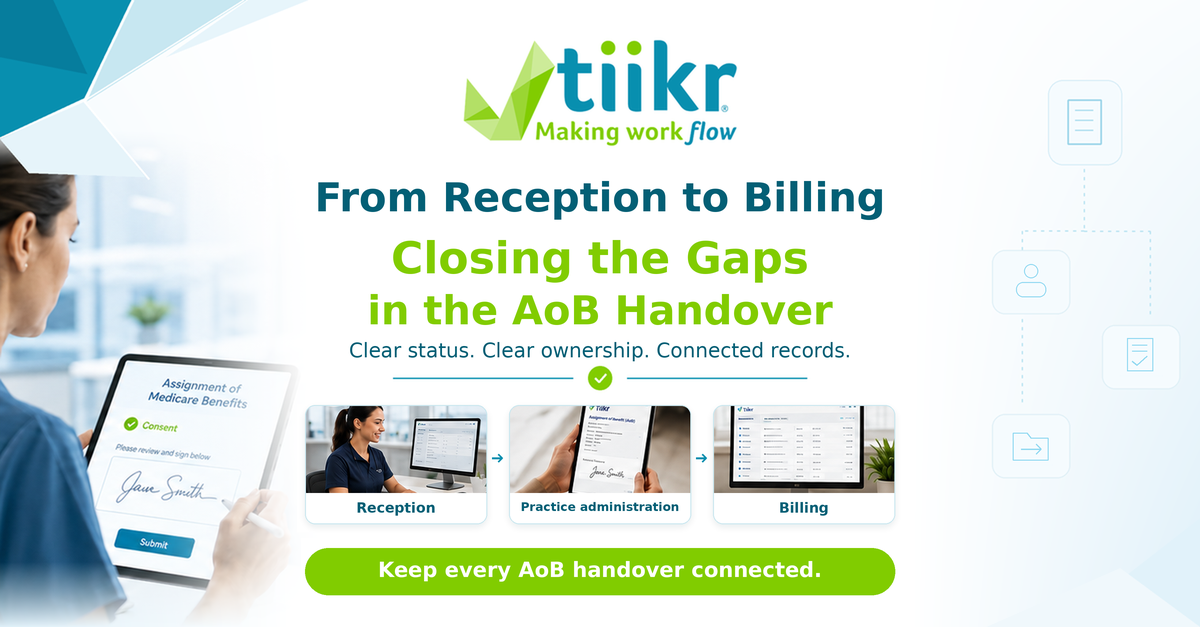
A patient completes their Medicare Assignment of Benefit agreement after leaving the practice. Reception has already handed the outstanding item to the afternoon team. The billing team, working elsewhere, still sees it as incomplete.
The agreement exists, but the people responsible for the next step do not know it.
This is the kind of handover gap that a medical practice can encounter when patient responses, staff tasks and billing records move through different systems or teams. As a result, staff may repeat phone calls, perform unnecessary checks and delay work while they establish what has happened.
For GP practices, specialist clinics and Medical Support Organisations (MSOs), improving the AoB handover starts with three practical questions:
- What has been completed?
- Who owns the next action?
- How will the next team know?
What should an AoB handover include?
An effective AoB handover gives the receiving team enough information to continue the work: the relevant patient, practitioner and service context; the agreement’s status; access to the supporting record; and any outstanding action with a named owner.
First, staff send the agreement. They must then receive the patient’s response, check it against the intended service and make the completed record available to billing.
Services Australia allows AoB agreements to be completed before or after the service, electronically or on paper. The agreement must contain the required information. Review Services Australia’s AoB guidance.
The Department’s bulk billing guidance confirms that the practitioner must obtain a valid AoB before submitting the Medicare claim. That makes a reliable handover to billing particularly important. Read the Department’s bulk billing FAQs.
Make the stages visible
A label such as “done” can mean different things to different teams.
For example, reception may use “done” when staff have sent the agreement. Meanwhile, the patient may use it after submitting a response. However, billing may expect the practice to have checked the agreement and made it available for the claim.
Use clear stages that describe what has actually happened.
Prepared
Staff have prepared the agreement for the relevant patient, practitioner and service. Next, they issue it through the appropriate channel.
Awaiting patient agreement
Staff have issued the agreement, but the patient or assignor has not yet responded. Therefore, the team responsible for monitoring and follow-up should keep the item visible.
Received—checking required
The practice has received a response. It must now confirm that the agreement is complete and relates to the appropriate patient, practitioner and service.
Action required
Something needs clarification or correction. The item should identify what is outstanding, who is responsible for resolving it and whether escalation is needed.
AoB check complete
The practice’s AoB checks are complete, and the supporting agreement is available to the authorised team responsible for the next stage of the billing process.
A digital response may update a stage automatically where the workflow supports it. Paper or other supported pathways may require an authorised staff member to record the change.
In either case, define what triggers each update. An email being delivered or a link being opened does not establish that the patient has agreed.
Keep claim submission, claim acceptance and payment as separate billing stages. Completing the AoB process does not establish that every other claiming requirement has been met.
Give outstanding work an owner
A shared inbox gives people access to messages. It does not necessarily tell them who is responsible for acting.
Every outstanding AoB item should have:
- an assigned person or team
- a clear description of the next action
- the most recent contact or activity
- an appropriate follow-up date
- an escalation route if the issue remains unresolved.
This is especially useful when staff change shifts, work part-time or provide cover at another location.
For example, an afternoon receptionist should be able to establish that a patient was contacted that morning, what assistance was offered and when another follow-up is due. They should not have to reconstruct the history from several inboxes.
Where a central team accepts responsibility, make that handover explicit. Sending the task should be followed by a clear indication that it has been assigned or accepted.
Coordinate patient reminders and staff notifications
Patient communication and internal task management serve different purposes.
A patient reminder helps someone complete an outstanding agreement or contact the practice for assistance. A staff notification tells an authorised team member that something needs action.
Design the two together.
If a patient completes an agreement, the workflow should stop further completion reminders. It should then move the response to the appropriate next step. If the patient calls the practice and resolves the issue through another supported pathway, staff need a way to record that outcome too.
Where a patient asks a question, declines or needs assistance, route the item to a person who can respond. Repeated reminders will not resolve those situations.
For practices using automated reminders, check how quickly a recorded response updates the reminder process. For manual follow-up, make the current status visible before another staff member contacts the patient.
Give billing the information it needs
The billing team needs to be able to connect the agreement to the work it is processing.
A practical handover should identify the relevant patient, rendering practitioner and service or episode, together with the agreement record and the outcome of the practice’s AoB checks.
If a material detail appears inconsistent, send it to the appropriate person for review. Administrative staff need a clear route to obtain clarification from the practitioner or responsible billing staff where necessary.
Avoid leaving unresolved questions inside a general “complete” status.
For specialist practices, the handover may follow the consultation once the practitioner establishes the service details. By comparison, a GP practice may collect the agreement earlier in the patient journey. Both workflows need a dependable way to establish that the agreement being used applies to the service being claimed.
Keep the record connected to the handover
A status update is most useful when authorised staff can reach the supporting agreement.
Agree where the completed record will be stored, how it will be identified and how the relevant team will retrieve it. If the agreement and billing information sit in different systems, test the connection between them.
That connection may be an integration, a controlled document transfer or a defined manual step. Make the process clear enough that staff can identify and resolve a failed transfer.
Services Australia requires practitioners to retain agreements for two years from the claim date. In addition, practitioners must provide a copy when the patient requests one. Review the AoB record-keeping requirements.
The handover therefore needs to support both today’s billing work and later retrieval.
How clearer handovers support MSOs
When an MSO supports several practices, AoB work may move between local reception teams, practice managers and central or outsourced billing staff.
Therefore, a common handover approach can help these teams:
- understand the same status labels across practices
- provide cover without repeating earlier work
- direct unresolved items to the correct practice or practitioner
- identify where a process or training issue needs attention
- coordinate patient contact across local and central teams.
Keep each task associated with its practice and practitioner. Access should reflect the role of the person receiving it and the arrangements under which the MSO supports that practice.
Central administration must also support practitioner accountability. The Department’s guidance states that the practitioner claiming the benefit remains responsible for retaining the agreements and producing them when requested, even when a practice, healthcare organisation or software provider stores the records. See the Department’s record-keeping guidance.
Test the handover with real scenarios
Walk through the process with reception, practice management and billing staff.
For example, test a patient response received after hours, a paper agreement, a service detail that needs clarification and a task transferred to another team during staff leave.
For each scenario, establish who sees the change, who acts next and where the record can be found.
Then measure whether the revised process reduces repeated checking and follow-up. Useful measures include:
- time between receiving an agreement and completing its handover
- outstanding items without an assigned owner
- duplicate patient contacts
- items returned by billing for clarification
- staff time spent locating agreements.
These measures help reveal whether the process is making everyday work easier.
Connect your AoB workflow with Tiikr
Tiikr’s digital forms and workflow platform provides a starting point for connecting information collection with the people responsible for the next action.
Therefore, an AoB deployment discussion should establish who initiates agreements, how the workflow records responses, who handles outstanding work and how completed records reach billing. Confirm the available automation and system connections against the practice’s actual setup.
Finally, a useful demonstration should follow an agreement through the whole journey, including a handover that needs attention.
Explore Tiikr’s Medicare AoB Solution and discuss how reception, practice administration and billing can work from a clearer, coordinated process.