
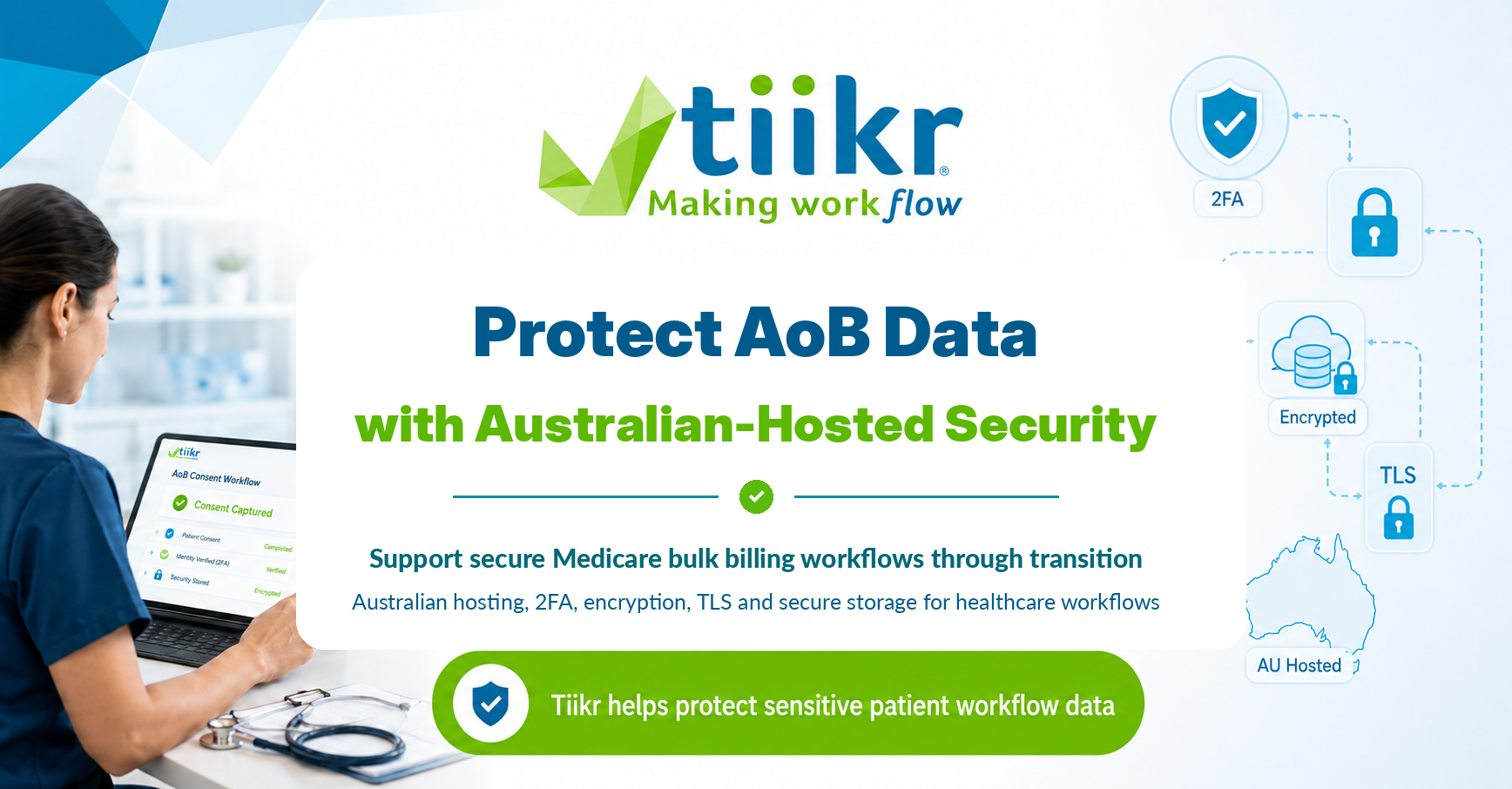
AoB data needs more than a signature process
Medicare Assignment of Benefit, or AoB, is often discussed as a consent or signature issue.
That is only part of the picture.
For GP clinics, specialist practices and healthcare administration teams, AoB also creates a data security and records management issue.
An AoB agreement may include patient details, service details, practitioner details, assignment information, signature evidence and completion history. It may also need to be stored, retrieved and provided later if requested.
That means practices should not only ask, “Can we capture the patient’s agreement?”
They should also ask:
-
- How is the agreement sent?
- How is the patient or assignor identified?
- Where is the completed agreement stored?
- Who can access it?
- Can it be retrieved later?
- Can the practice provide a copy if requested?
- Is the workflow appropriate for sensitive healthcare information?
These questions matter because AoB is not just a form. It is a patient consent and Medicare billing record that may need to be relied on later.
What the official guidance says about AoB records
Services Australia states that when a practitioner bulk bills a patient, they must obtain a completed Assignment of Benefit agreement from the patient, or an assignor on their behalf.
The official Services Australia guidance also explains that from 1 July 2026:
-
- assignment can be made either electronically or on paper
- the agreement must include required information
- health professionals need to retain a copy of the agreement for two years from the date the claim is made
- patients are no longer required to keep a copy, but providers must give the patient a copy if requested
That makes security and retrieval part of the same operational problem.
The completed record needs to be protected, but it also needs to remain accessible to authorised practice staff when required.
Why security matters for GP practices
GP practices can have high AoB volume.
A process that looks manageable for five or ten patients can become a real administrative burden when repeated across a busy practice day. If AoB records are handled inconsistently, staff may end up scanning, emailing, saving, renaming and filing documents manually.
That creates risk.
The risk is not only that a record may be misplaced. It is also that sensitive patient and Medicare information may be stored or shared in ways that are difficult to control.
A secure AoB workflow should help reduce that risk by making the correct pathway the easiest pathway.
For GP practices, that means:
-
- secure patient completion options
- controlled access to completed agreements
- consistent storage
- clear completion status
- reliable retrieval
- less reliance on email attachments and ad hoc file storage
Why security matters for specialist practices
Specialist practices may have more variable AoB workflows.
The service details may change. The final MBS item may not be known until after the consultation. A different practitioner may render the service. A patient may require an assignor. There may be more complex administrative handover between clinical, reception and billing staff.
That variation increases the need for a structured and secure workflow.
Specialist practices need AoB records to be attached to the right patient, service context, practitioner and billing process. They also need to avoid having completed agreements scattered across inboxes, download folders, shared drives or paper files.
A secure digital workflow helps reduce that fragmentation.
Australian-hosted security and data sovereignty
For Australian medical practices, data sovereignty is an important consideration.
AoB agreements involve health-related information and Medicare workflow data. Practices should understand where data is hosted, how it is protected, how access is controlled and how completed records can be retained.
This does not mean every practice needs to become a security expert.
It does mean the practice should choose digital workflow tools that are built with healthcare data sensitivity in mind.
A practical security checklist should include:
-
- Australian hosting
- encrypted data in transit
- encrypted data at rest
- secure access controls
- controlled user permissions
- audit-ready record handling
- reliable backup and recovery processes
- clear record retrieval and export options
AoB security should support the workflow, not slow it down
A secure process will fail if staff cannot use it properly.
If the workflow is too hard, people will create workarounds. They may print, scan, email, save locally, rename files manually, or store agreements in inconsistent locations.
That is why security and usability need to work together.
A good AoB workflow should guide staff through the right process. It should not rely on every staff member remembering every step each time.
For example, a structured digital workflow can help ensure that:
-
- the agreement is created from the correct template
- required fields are completed
- the patient or assignor completes their part
- the signed record is stored consistently
- the agreement is locked or controlled after completion
- the record can be found later by authorised staff
This is where workflow design becomes a security issue.
How Tiikr helps protect AoB data
Tiikr helps practices manage AoB as a structured workflow, not just a signed document.
The Tiikr Medicare Assignment of Benefits solution supports the practical steps involved in starting, completing, signing, storing and retrieving AoB agreements.
For practices, the goal is to reduce fragmented handling of sensitive records.
Instead of relying on disconnected paper, email and local file storage, Tiikr helps the AoB agreement move through a more controlled process.
That matters because the completed agreement is not just information. It is evidence.
It needs to be protected, retained and retrievable.
Frequently Asked Questions About AoB Data Security
Why does AoB data security matter?
AoB data security matters because Assignment of Benefit agreements can include sensitive patient, service, practitioner and Medicare billing information. Practices need to protect that information while still being able to retrieve completed records when required.
How long do AoB agreements need to be retained?
Services Australia states that health professionals need to retain a copy of the Assignment of Benefit agreement for two years from the date the claim is made.
Should AoB records be stored digitally?
AoB records can be managed electronically or on paper. However, for many practices, a secure digital workflow may make it easier to control access, reduce manual filing, retrieve records and provide copies when requested.
A practical next step
Review how your practice currently stores completed AoB agreements.
Then ask:
-
- Can authorised staff find a completed agreement quickly?
- Can the practice identify who completed it and when?
- Can the patient receive a copy if requested?
- Can the practice avoid uncontrolled email attachments and local file storage?
- If not, it may be time to move AoB into a more secure digital workflow
Book an AoB readiness review with Tiikr and see how secure digital AoB workflows can support your practice.